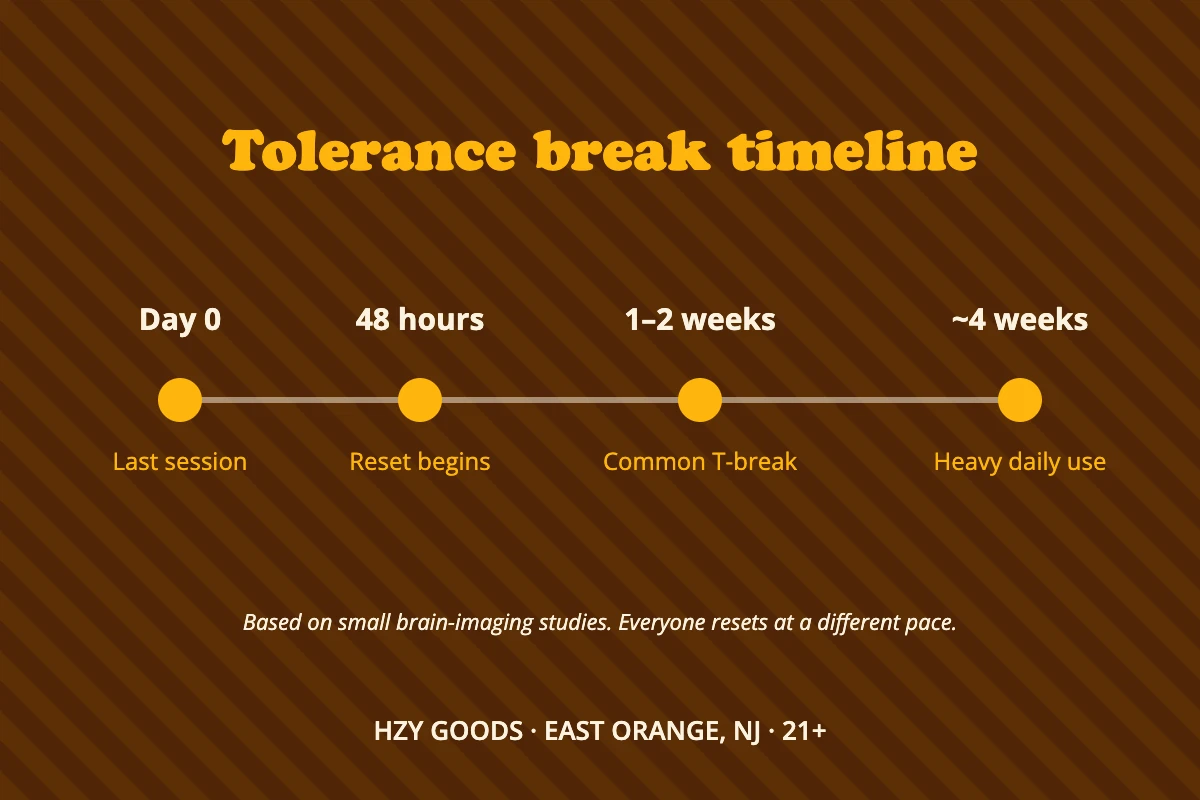
The short answer: a tolerance break (or “T-break”) is time off from THC so it works like it used to. Research suggests your body starts resetting within about 48 hours. Many people take 1–2 weeks, and heavy daily users may need around 4 weeks for a full reset.
For adults 21+. General information, not medical advice.
Why Tolerance Builds Up
THC works by binding to CB1 receptors in your brain. With regular use, your brain adapts by reducing how many of those receptors are available. Fewer receptors means the same amount of THC does less, so you need more to feel the same effect. That’s tolerance.
How Long Does a Tolerance Break Take?
| Break length | What to expect |
|---|---|
| 48 hours | Receptors start to recover. Many people notice a small difference. |
| 1 week | A noticeable reset for occasional and moderate users. |
| 2 weeks | A common T-break. Withdrawal effects have usually eased by now. |
| About 4 weeks | Closer to a full reset, especially for heavy daily users. |
What the Research Says
- A 2012 brain-imaging study in Molecular Psychiatry (Hirvonen et al.) found chronic daily cannabis users had fewer available CB1 receptors, and that this reversed after about 4 weeks without cannabis.
- A study from Yale researchers (D’Souza et al.) found receptor availability started recovering within about 2 days of stopping, and kept improving over 4 weeks.
Both studies were small, and everyone resets at a different pace. But together they explain why even a short break helps, and why longer breaks help more.
What to Expect During a T-Break
If you’ve been using daily, the first few days can be uncomfortable. Common, temporary effects include:
- Irritability or restlessness
- Trouble sleeping or vivid dreams
- Lower appetite
- Cravings
For many people these effects ease within 1–2 weeks. Exercise, a regular sleep schedule and staying busy help.
Tips for a Successful Tolerance Break
- Pick a start date. A quieter week makes it easier.
- Clear out your stash or store it somewhere out of sight.
- Change your routine around the times you’d usually use.
- Tell a friend. It’s easier with someone keeping you honest.
Can’t Take a Full Break? Lower Your Tolerance Gradually
- Use less often. Skip days instead of stopping completely.
- Take smaller doses. One or two puffs, or a 2.5 to 5 mg edible.
- Pick lower-THC products. Save 30% THC flower like Animal Face for occasional use.
- Rotate strains. Many people find switching things up helps, though the research on this is limited.
Coming Back After a Break
Your tolerance will be lower, so start small. Have much less than you used to, and wait before having more, especially with edibles. A balanced strain like Blue Dream is a gentle way back in. Browse our strain guide or ask a budtender at HZY Goods, 19 Prospect St, East Orange.
Wondering how long THC stays detectable after you stop? See How Long Does THC Stay in Your System?
Frequently Asked Questions
How long should a tolerance break be?
Many people notice a difference after 2 days, and 1–2 weeks is a common break. Heavy daily users may need closer to 4 weeks for a full reset, based on brain-imaging research.
Does a 48-hour tolerance break work?
Partly. Research suggests your cannabinoid receptors start recovering within about 2 days, so even a short break can help. Longer breaks reset tolerance more fully.
What happens during a tolerance break?
Some people feel irritable or restless, sleep poorly, have vivid dreams or lose some appetite for the first several days. For many people these effects ease within 1–2 weeks.
How do I lower my tolerance without stopping completely?
Use less often, take smaller doses, pick lower-THC products, or save higher-THC products for occasional use.
How much should I use after a tolerance break?
Much less than before. Your tolerance will be lower, so start with a small amount and wait before having more.
What if I can’t take a break?
If cutting back feels hard, you’re not alone. SAMHSA’s free, confidential National Helpline is 1-800-662-4357, available 24/7.
For adults 21+. This guide is general information, not medical advice. If cutting back is hard, SAMHSA’s National Helpline (1-800-662-4357) is free, confidential and open 24/7. Sources: Hirvonen J et al., Mol Psychiatry 2012; D’Souza DC et al., Biol Psychiatry Cogn Neurosci Neuroimaging 2016.